The two facts that disagree
Almost everything written about the Dodow online is paid placement. When we went looking for something independent, we found one thing worth reading and one number worth taking seriously, and they point in opposite directions.
CNN Underscored tested it for over two months. A named reporter, Benjamin Levin, who describes himself as a light sleeper who struggles to drop off. His verdict: it helped, consistently, and within a few nights he was falling asleep before the eight-minute cycle ended. He also explains the mechanism correctly, without inflating it.
Amazon has 11,386 ratings and they average 3.3 out of 5. That is the largest independent sample attached to any product we have looked at, and 3.3 is not a good score. It is not a disaster either. It is the number you get when a thing works properly for a lot of people and does nothing at all for a lot of others.
We are not going to resolve that for you, because it cannot be resolved. One careful reviewer is an anecdote. Eleven thousand buyers is a distribution. Both are true at once, and what they add up to is: this is a coin flip you can only settle by trying it.
Which is why the single most useful feature of this product is the 100-day money-back guarantee, and the most useful thing we can tell you is to treat those 100 days as the actual test.
What it actually does
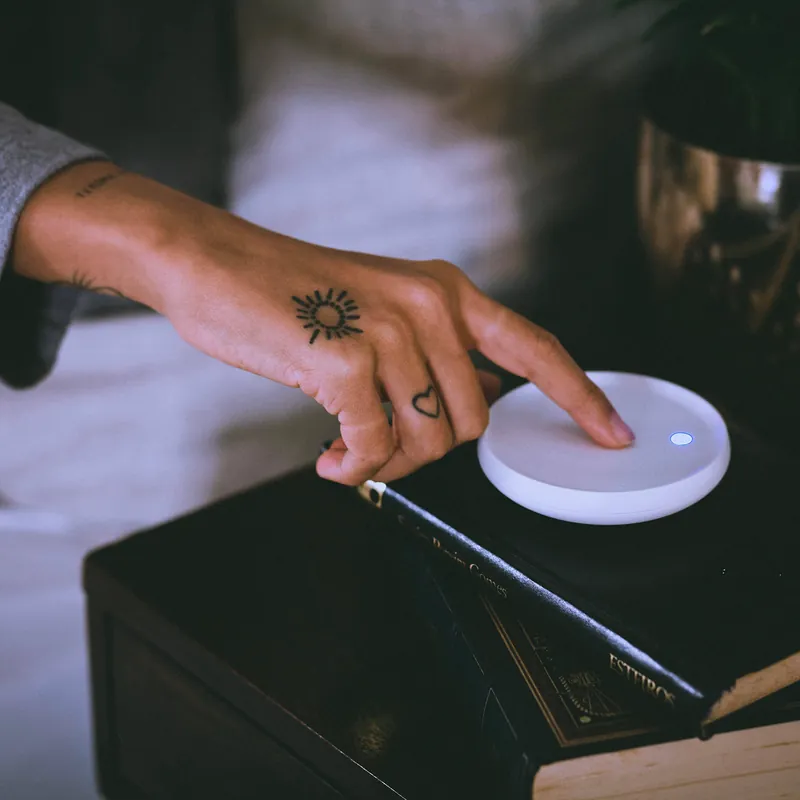
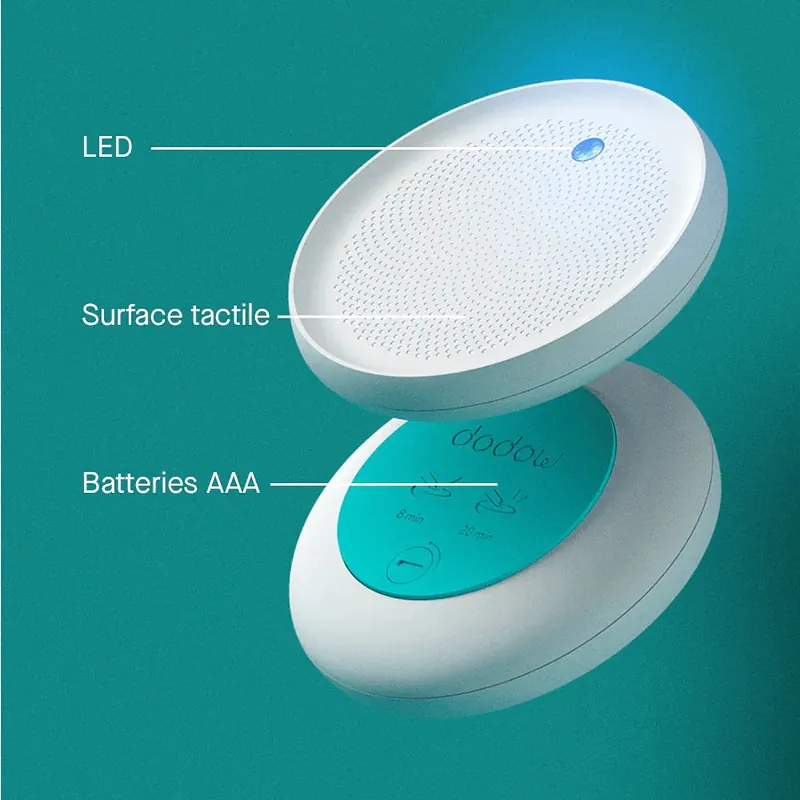
You tap the top. A soft blue light projects onto the ceiling, expanding and contracting. You breathe in as it grows and out as it shrinks. It slows over the cycle until you are breathing about six times a minute, then switches itself off. Eight minutes or twenty, your choice, at one of three brightness levels. It runs on three AAA batteries and there is nothing to charge, subscribe to or refill.
The physiology is not in dispute. Breathing slowly, with a longer out-breath than in-breath, increases parasympathetic activity — the branch of your nervous system that lowers heart rate and relaxes muscle. It is the same principle behind box breathing and the 4-7-8 pattern, and it is taught in clinical settings. This is the honest core of the product.
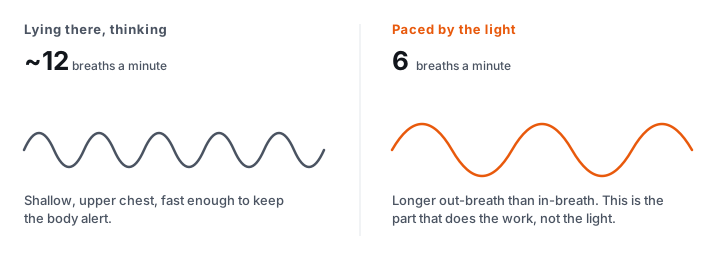
Notice what is doing the work in that diagram. It is the breathing rate, not the light. The light is a pacing device — a metronome you do not have to hold. That is a real convenience and we will come back to whether it is a $59 convenience.
What the sales page claims, and what we can stand behind
The landing page you reach through our link makes four claims we would not put our name to.
“Fall asleep 2.5x faster.” This comes from the company’s own customer survey, not a controlled trial. We could not find a published randomised trial of the Dodow. A number that specific, from a self-selected group of buyers, is marketing.
“Inspired by 13,000 sleep studies.” Being inspired by studies is not being tested by one. The sentence is built to read like evidence while claiming nothing.
“Retrains your brain to fall asleep on its own.” Paced breathing helps you relax tonight. That it durably rewires anything is a much larger claim and there is nothing behind it. If it works for you, expect a nightly tool, not a cure you graduate from.
The comparison against sleeping pills. The page sets Dodow against “sleeping pills” on dependency and long-term use, and runs a testimonial headlined “so happy I stopped taking sleeping pills.” The pill named is an over-the-counter antihistamine, so nobody is in danger here — but a light on your ceiling is not a substitute for anything you were prescribed, and we are not going to imply otherwise.
Where it disappoints
We have not tested it, so these come from the independent reviews and from what the design plainly cannot do.
A third of buyers are not impressed. That 3.3 average is the headline weakness. The most common thread is simply that it did nothing for them — they followed the light, stayed awake, and returned it or did not bother.
It asks you to concentrate. Following a light and matching your breath is an active task. If your problem is a mind that races, being handed one more thing to do can backfire, and the product page’s own advice — do not try to fall asleep — is harder than it sounds.
It does one thing. No alarm, no sound, no app, no data. That is a virtue if you wanted a metronome and a disappointment if you expected a sleep tracker for the money.
It is a light in a dark room. At under one lux it is dim, and there are three levels, but if you share a bed with someone who needs total darkness, that is a conversation before it is a purchase.
What it costs, and the version that is free
One unit is a wash. The funnel charges $59. Amazon charges $59.90. Ninety cents apart. If you want exactly one, buy it wherever you already have an account, and we will earn nothing on it — Amazon will also take it back more easily than a returns form will.
The packs are where our link is worth using. Two for $88.50 is $44.25 each; three for $118 is $39.33 each, both with free shipping. Nothing at retail is close. Whether that helps depends on whether a second one has somewhere to go — a partner, a spare room, a gift for the person in your life who complains about sleep. If the answer is no, buy one on Amazon.
And now the awkward part. Every breathing app on your phone does the pacing for nothing. So does the 4-7-8 pattern, which requires no equipment at all. If what you need is a rhythm to follow, you already own several ways to get one, and they cost zero dollars.
The honest argument for the device is narrow but real: it is not a phone. Reaching for a screen at the moment you are trying to wind down is the single most self-defeating thing a bad sleeper does, and an app — however good — requires exactly that. A disc on the nightstand that projects onto the ceiling and switches itself off keeps the phone out of the room. If you have tried the free version and lost the battle with the phone, that is what you are paying $59 for. If you have not tried the free version, try it first. It costs you a week.
For
- The mechanism is real physiology, not invented
- Independently tested by CNN over two months, positively
- No screen at bedtime — the genuine case for hardware
- No subscription, no refills, batteries last months
- 100-day money-back guarantee, the longest we have seen
- Packs land well below Amazon
Against
- 3.3 out of 5 across 11,386 Amazon ratings
- A free breathing app does the same pacing
- One unit costs the same as on Amazon
- “2.5x faster” comes from an in-house survey, not a trial
- “Retrains your brain” has nothing behind it
- Asks you to concentrate, which can backfire
- Not tested by us
Is it worth it?
Worth trying if you fall asleep slowly because your mind will not stop, you have already found that slow breathing helps when you remember to do it, and the thing standing between you and doing it is that the timer is on your phone. That is a specific person, and for them $59 buys a working solution to a real problem.
Not worth it if you have never tried paced breathing — do that free first — or if you are hoping for a device that measures anything, or if what keeps you awake is pain, a newborn, or a schedule. No metronome fixes those.
And one thing the product page will never tell you. If you have not slept properly for months, the first-line treatment for chronic insomnia is cognitive behavioural therapy for insomnia — CBT-I. It outperforms sleeping medication in the long run and it is what a sleep clinician will start with. A $59 light is a reasonable thing to try for a restless week. It is not the thing to try instead of getting help for a problem that has lasted a season.
Two for $88.50 — $44.25 each, free shipping
SEE THE PACKS →100-day money-back guarantee · a single unit costs the same on Amazon