You were fine all day. You get into bed, turn off the light, and within ninety seconds your brain opens a folder labelled “everything.” The email you should have sent. The thing you said in 2011. Whether you locked the back door. This is not a character flaw and you are not doing it to yourself on purpose.
Nothing else was competing for the space
For sixteen hours your attention had somewhere to go. Work, traffic, a screen, a conversation, the next thing. Thinking was continuously crowded out by doing.
Then you lie down in a dark, quiet room with no task in front of you, and the queue that was never processed gets its turn. Your brain is not malfunctioning at 11pm. It is finally idle, and idle is when it files things.
This is why “just stop thinking about it” has never worked for anyone. You cannot empty attention. You can only give it something else to hold.
And then the second thing happens
Twenty minutes in, you check the clock. Now you are not just awake — you are awake and keeping score. Six hours left. Five and a half. You start calculating how bad tomorrow will be, which is itself a stressor, which raises your heart rate, which makes sleep less likely, which gives you more to calculate.
Sleep clinicians have a name for this loop, and the important thing about it is that the harder you try to break it by effort, the tighter it gets. Trying to fall asleep is an active, alert state. It is the opposite of the thing you are trying to do.
What your body is actually waiting for
Falling asleep is not a decision. It is a handover between two branches of your nervous system — from the one that keeps you alert and ready to the one that slows your heart, drops your muscle tone and lets you go under.
You cannot order that handover to happen. But you can send the signals that normally accompany it, and the body reads the signals.
The most reliable of those signals is your breathing. Fast, shallow, upper-chest breathing is what a body does when something is happening. Slow breathing, with a longer out-breath than in-breath, is what a body does when nothing is. Deliberately producing the second one is one of the few direct levers you have on a system you otherwise do not control.
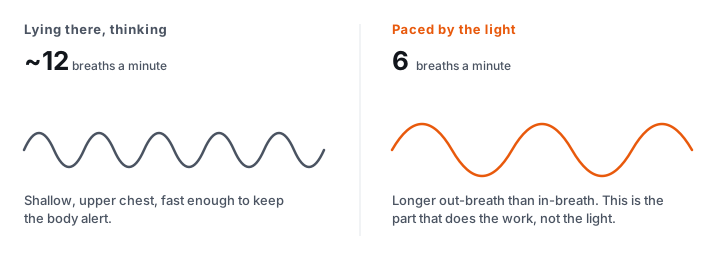
Around six breaths a minute is where this works best. That is roughly half of resting rate, and it is slow enough that you have to pay attention to hold it — which is the second thing it does. It gives the folder-opening part of your brain a small, boring, continuous job.
Which is where the counting falls apart
Everyone who has tried this knows the failure mode. You start counting your breath. Four in, six out. Four in, six out. Four in — and you are thinking about the email again, and you have no idea whether you are on breath nine or nineteen.
Holding a rhythm yourself requires the exact faculty you are trying to switch off. So you reach for a timer, and the timer is on your phone, and now there is a lit screen in your hand at the precise moment you were trying to leave the day behind.
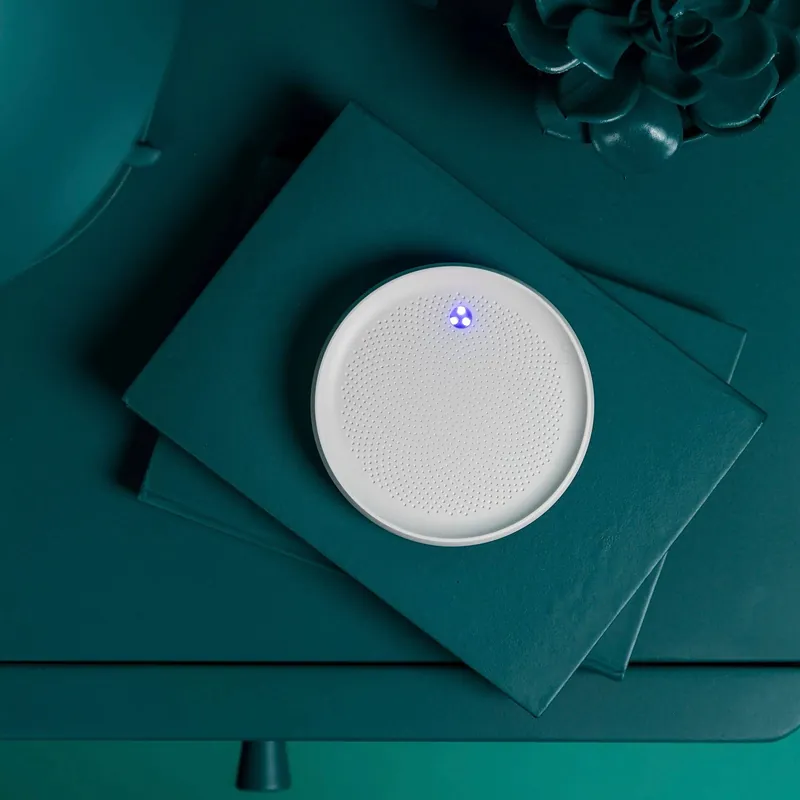
This is the gap the Dodow is built for. It projects a slow blue pulse onto the ceiling — you breathe in as it grows, out as it shrinks. You are not counting and you are not holding a screen. It slows down over eight or twenty minutes and then turns itself off.
Whether that is worth $59 to you is a real question and we go through it properly in the review, including the part where 11,386 Amazon buyers rate it 3.3 out of 5. But the problem it aims at is the right problem, and it is one almost nothing else in the sleep aisle even tries to address.
If this has gone on for months rather than nights, none of the above is the answer. Chronic insomnia has a first-line treatment — CBT-I — and it works better than anything you can buy. Start there.