I did not buy anything for the first month. I want to say that up front, because the usual version of this article skips it, and skipping it is what makes people distrust articles like this one.
My problem was ordinary: I fall asleep slowly, roughly forty minutes on a normal night, longer if something is on my mind. Not a medical problem. Just forty minutes a night I would rather have back.
What I tried, and what it cost
Someone told me that slow breathing was the only sleep advice with anything behind it, so I started there, and I started free.
The 4-7-8 pattern. In for four, hold for seven, out for eight. No equipment. It works — the first few nights I noticed myself getting heavier partway through. What I could not do was keep counting without my mind wandering off mid-cycle and losing the thread. Some nights I would realise I had been lying there thinking about work for ten minutes with my breathing back to normal.
Breathing apps. There are dozens and several are genuinely good. They pace you visually, they do not need you to count, and the free tiers are perfectly adequate. This solved the counting problem completely.
And it created a worse one.
The phone is the problem
To start the app I had to pick up my phone. Which was face-down on the nightstand, which meant turning it over, which meant seeing whatever had arrived since I put it there.
Most nights this cost me nothing. Some nights it cost me an hour, because the thing on the screen was a message I then had to think about, or a headline, or just the two minutes of scrolling that turns into fifteen. The tool that was supposed to wind me down required me to open the single most winding-up object I own.
I tried the obvious fixes. Open the app before getting into bed. Turn on Do Not Disturb first. Put the phone across the room and walk back. All of them worked and none of them lasted, because they all depended on me being disciplined at the exact hour of day when I have the least discipline available.
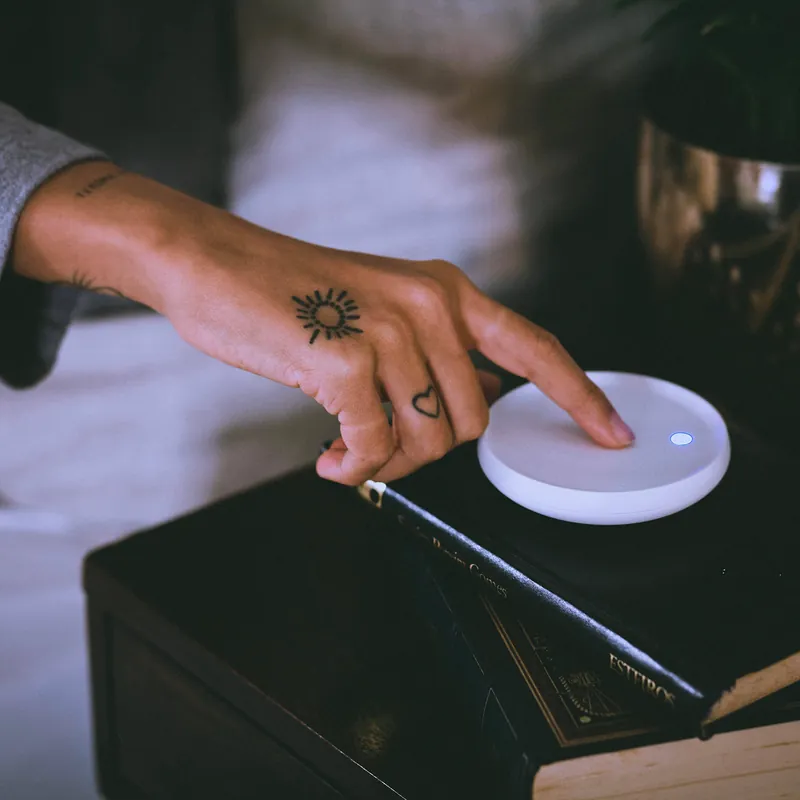
So what I actually bought was the absence of a screen
That is the honest framing of what a Dodow is. It is a disc on the nightstand that you tap in the dark without looking at it. A slow blue light appears on the ceiling. You breathe in as it expands and out as it contracts, it gradually slows you to about six breaths a minute, and after eight or twenty minutes it switches itself off.
Functionally, it does what the free app did. The difference is that nothing lights up in my hand, nothing has a notification on it, and I never find out what happened on the internet while I was brushing my teeth.
Fifty-nine dollars is a lot for a breathing pacer. It is not a lot for reliably keeping a phone out of my hands at bedtime, which is the thing I had failed at on my own for a month.
What I would tell someone before they buy one
Do the free month first. Genuinely. If paced breathing does nothing for you, a nicer way to deliver it will also do nothing for you, and you will have spent $59 finding that out. Try 4-7-8 or any free app for a couple of weeks and see whether the technique itself moves anything.
Know that it does not work for everyone. Our full review puts the number on it: 11,386 Amazon buyers average it 3.3 out of 5. That is a lot of people for whom this did nothing. It is genuinely a coin flip, which is why I would not have bought one without the 100-day guarantee.
Buy one on Amazon if you only want one. It is $59.90 there against $59 through the link on this page, which is the same money. The packs are the only place the price actually moves — two for $88.50 works out at $44.25 each — and that only helps if a second one has somewhere to go.
Two for $88.50 — $44.25 each, free shipping
SEE THE PACKS →100-day money-back guarantee · a single unit costs the same on Amazon
Want the case against it? Our review scores it 6.5 out of 10 and lists the four claims on the sales page we would not put our name to.