There is a trick in consumer hardware so old that it has a name, and the name comes from razors. Sell the handle cheaply. Sell the blades forever. Nobody in beauty devices calls it that, but a startling number of the things on the shelf are built exactly that way, and the price on the box is the least interesting number about them.
I am not writing this to complain about it. Consumables are often the honest part of a design — something has to wear out, and pretending otherwise would be worse engineering. What I want to argue is narrower: the running cost is knowable before you buy, it takes about four minutes to find, and almost nobody looks.
The four-minute check
Before buying any device that touches skin, hair or teeth, I would do these in order.
One: find the part that wears out. Open the manufacturer’s own shop page and look at what else they sell for that device. If there is a refill, a head, a filter, a cartridge, a pad or a disc, that is the real product and the device is the delivery mechanism. If there is genuinely nothing, that is worth knowing too — and it is rarer than you would think.
Two: find the manufacturer’s replacement interval. Not a review’s guess — theirs, in their own words, usually buried in an FAQ rather than on the sales page. It will be phrased as advice about performance (“for best results”) rather than as a cost, because a company writing its own instructions is not in the business of telling you what its instructions cost.
Three: multiply. Recommended frequency of use, divided by the replacement interval, times the price of a pack. This is one line of arithmetic and it is the number the sticker was hiding.
Four: add it to the sticker over three years. Three years, because that is roughly how long a working device lives in a bathroom drawer before it is replaced, lost or abandoned, and because one year flatters a consumable and ten years is a fantasy about your own consistency.
What the arithmetic did to the device we reviewed
Our review this week is of an at-home microdermabrasion device, and it is a useful worked example precisely because the product is decent and the page selling it is not careful.
The sticker is $99.99, and the sales page states in plain words that there are no recurring costs. The manufacturer’s instruction, on the manufacturer’s own site, is to use it once a week and to replace the disc every three to four uses. Replacement discs are $20 for a six-pack, of which four are the face size.
Fifty-two treatments a year, at three to four per disc, is thirteen to seventeen discs. That is between three and a half and four and a bit packs. Sixty-five to eighty-five dollars a year, from the company’s own two sentences, on a product whose page says the running cost is zero.
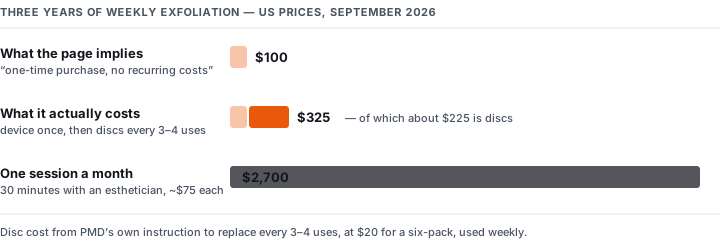
And now the part that makes this worth writing rather than just worth grumbling about. Look at the third bar.
The real cost of the device is three times what the page implies — and still an eighth of what the alternative costs. Both of those are true at once, and the second one is a genuinely good argument that the seller threw away in order to make the first one look prettier.
That is the thing I find hard to forgive in this category. Not that the discs cost money. That the honest version of the pitch — three hundred and twenty-five dollars over three years against two thousand seven hundred — was already overwhelming, and somebody decided it needed help.
What the consumable tells you that the review cannot
There is a second reason to do this arithmetic, and it has nothing to do with money.
The refill schedule tells you whether you will actually use the thing. A device that needs a new part every month needs you to notice, reorder and restock every month, and the honest question is not whether you can afford $20 four times a year. It is whether you are a person who reorders.
Every bathroom drawer I have ever seen has an electric toothbrush with a head from two years ago on it, still being used, still technically working, doing a fraction of what it was sold as doing. Nobody decided to do that. They just did not reorder, and the device kept switching on, which is the worst possible feedback.
Abrasive devices are the same and slightly worse, because a worn disc feels gentler rather than broken. The machine still hums. The treatment still takes three minutes. It simply stops doing anything, and the person concludes the product was overhyped when what actually happened is that they ran out of the product.
So when you do the four-minute check, do not stop at the annual figure. Ask the harder question: am I going to keep buying these? If the answer is no, the right move is not a cheaper device. It is to buy the treatment from someone whose job is to have a fresh one, and to keep the hundred dollars.
The rule I would take away
A device with a consumable is a subscription with an opt-out. That is not an insult — it is just the shape of the thing, and once you see it that way the decision gets easier. You are not choosing between $99.99 and nothing. You are choosing between roughly $10 a month, forever, and whatever you were doing before.
At $10 a month against $75 a session, this particular device is still a straightforward yes for anyone who was paying for facials. It just deserved to be sold that way.
The device itself: $99.99, the lowest price of any channel today
CHECK THE CURRENT PRICE →Budget $65–$85 a year for discs · our full review checks the other claims on that page