What it is, without the adjectives
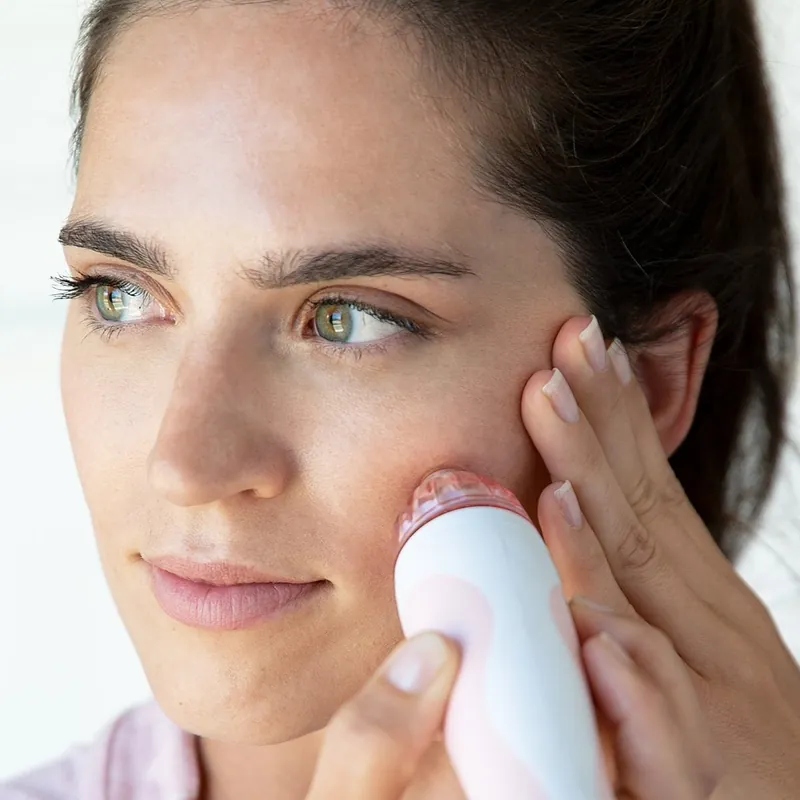
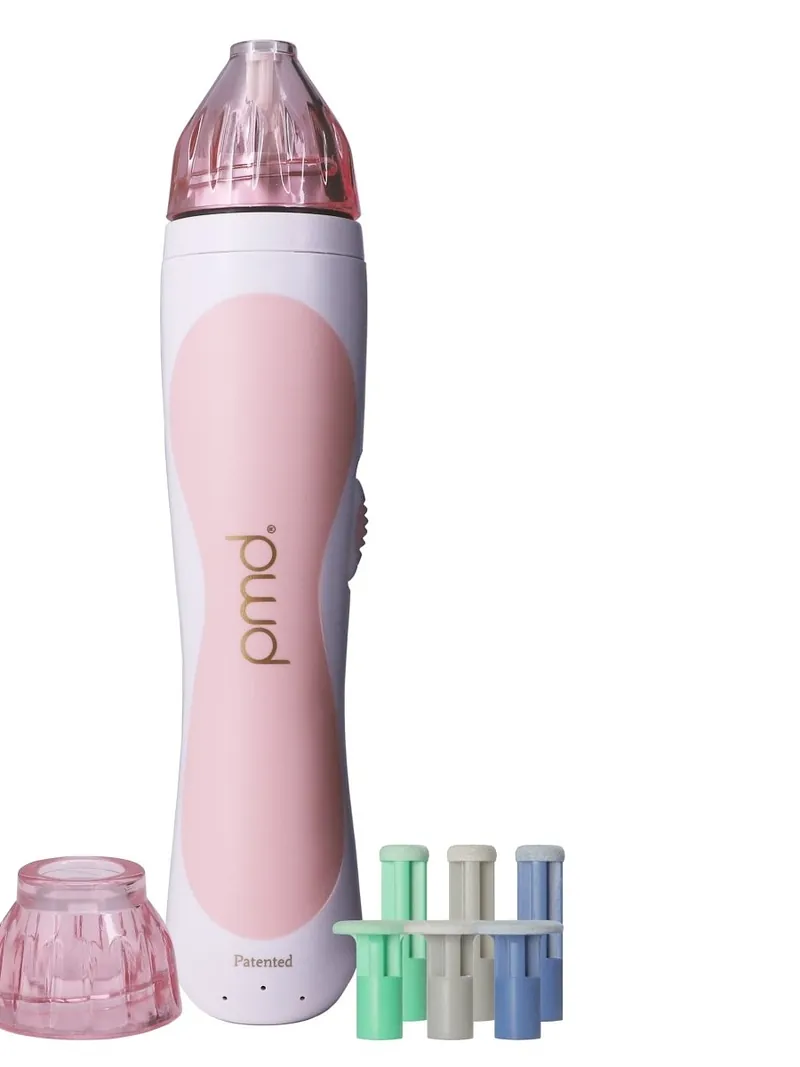
A handheld device with two things going on at the tip. A disc coated in aluminium oxide crystals spins against your skin and abrades the surface layer. At the same time a small vacuum lifts the skin slightly toward the disc and pulls away what comes off. You move it across clean, dry skin in short passes, once a week, for about three minutes.
That is mechanical exfoliation. It is the same idea as the microdermabrasion an esthetician does, at lower intensity, which is exactly what you would expect from a $100 consumer device against a machine in a clinic. Nothing about it is mysterious and nothing about it is fake.
The category is also genuinely useful for a specific complaint: dull, rough, uneven surface texture. If that is your problem, a device like this addresses it directly. If your problem is deeper — wrinkles, pigment, scarring — you are in the territory where in-office treatment exists for a reason.
The first number that does not hold: “37% off”
The advertorial that leads to this offer promises 37% off when you order direct from the brand. That is measured against PMD’s list price of $159, and against $159 the arithmetic is right: $99.99 is 37% less.
Except PMD is not charging $159 today. Its own website is running 30% off sitewide, and the Classic’s product page is literally titled “Personal Microderm Classic — 30% Off Limited Time” at $111.30. A product page named after its own discount is not a flash sale; it is the price.
So the honest saving is $11.31, or about 10% — not $59. That still makes the offer the cheapest place to buy this device, and we will say so plainly. It is just a tenth of the discount the page is selling you.
| Where | Price today | Rating |
|---|---|---|
| This offer | $99.99 | — |
| pmdbeauty.com | $111.30 (30% off $159) | — |
| Ulta | $159.00 | 4.4/5 from 698 reviews |
| Best Buy | Sold out | 4.5/5 from 42 reviews |
One thing worth saying for the brand: those ratings are the reason to take this seriously at all. 698 reviews at 4.4 is a real sample from a retailer with no stake in a funnel, and it is a better number than most things in this category can show.
The second number that does not hold: “no recurring costs”
The sales page says it directly: no appointments, no expensive follow-ups, and no recurring costs — a one-time purchase.
The discs are consumable. They are coated in crystals, the crystals wear down, and a worn disc stops exfoliating. This is not a criticism we invented; it is PMD’s own instruction, on PMD’s own site: “In order to get the maximum exfoliation from each treatment, replace your disc every 3-4 uses.”
Now put that next to the other instruction — use it once a week — and the running cost falls out of their own two sentences:
- 52 treatments a year, one disc per 3–4 treatments, is 13 to 17 face discs a year.
- A replacement pack is $20 and holds six discs: four small (face) and two large (body).
- Weekly facial use therefore burns roughly three and a half to four packs a year: $65 to $85.
Over three years that is $99.99 plus about $225 in discs — call it $325, against the $99.99 on the page. The device is a one-time purchase. The treatment is not.
And here is the part that is fair to PMD. Once you have that real number, run it against the thing the page is comparing itself to. A professional microdermabrasion session runs about $75 for thirty minutes and $170 or so for an hour, and the usual protocol is a few weekly sessions and then monthly maintenance. Monthly at $75 is $900 a year.
So the claim that this saves you a great deal against a spa habit is true, and it survives the disc costs with enormous room to spare. The page did not need to pretend the discs are free. It chose to, and that is the part we would not put our name to.
The clinical study, checked
The page leans on “a clinical study led by renowned dermatologist Dr. Mark Taylor” and lists results: 100% of users reported smoother skin, 91% a visible glow, 85% improved skin density.
Dr. Mark Taylor is real, and PMD credits him with helping develop the device. But PMD’s own page about him is a testimonial, and the substantive line on it is one sentence: “It’s a well designed and safe and effective device for home use.” There is no journal named, no participant count, no methodology, no citation. We could not find a peer-reviewed publication behind those percentages.
Read the numbers again with that in mind. “100% of users reported smoother skin” and “89% noticed revitalised skin” are people answering a questionnaire about a device they were given, which is a satisfaction survey. A survey is not nothing — but it is not what the phrase “clinical study” is doing there, which is borrowing the authority of a trial.
Same for “skincare penetrates 20x deeper.” Removing dead surface cells does help what you put on afterwards absorb. Twenty times is a number with no source we can find, and it is the kind of precision that exists to sound measured.
Where it disappoints
We have not tested it, so these come from published dermatology guidance and from what the design plainly cannot do.
An at-home device is milder than the clinic, and the risk moves the other way. Dermatology sources are consistent: office machines have stronger abrasion and suction, so results are more dramatic there, while retail devices produce gentler outcomes with a higher risk of irritation, damage and scarring when they are used wrong. The device is not less safe because it is weaker — it is less safe because nobody is supervising the person holding it.
The instructions are the product. Once a week, three minutes, one or two passes, clean dry skin, starting with the mildest disc. Everything that goes wrong with these devices goes wrong because someone decided that if weekly is good, twice a week is better. There is no version of this where more is faster.
The starter discs run out faster than people expect. PMD’s product page lists the Classic with the device, a face cap, a body cap and a small starter set of discs. At three to four uses each, a handful of discs is a couple of months of weekly treatments — and then the $20 packs start.
It is a surface treatment being sold with the vocabulary of a deeper one. Collagen production, skin density, cellular regeneration. Mechanical exfoliation does prompt some renewal at the surface, and a light suction does bring blood to the area. Neither is a resurfacing procedure, and if you are buying it expecting what a laser does, you will be disappointed by a device that is working exactly as designed.
Who should not use this at all
The sales page does not have a paragraph like this and we think that is the real omission — bigger than the pricing. Published guidance says microdermabrasion should be avoided, or only done under medical advice, if you have:
- Active acne, rosacea, eczema or atopic dermatitis — abrasion can inflame all of them further
- A history of scarring easily, including keloids
- Recent or current isotretinoin (Accutane and its relatives)
- Any mole or spot that is changing, growing or bleeding — that is a dermatologist appointment, not an exfoliation problem
Deeper skin tones are not excluded, but the guidance is to start at the mildest setting and go slowly, because post-inflammatory pigmentation is a real risk with any abrasive treatment. And whatever your skin, expect redness for up to a day, and use sunscreen — you have just removed the layer that was standing between you and the sun. If anything is still irritated after 24 hours, that is a call to a doctor, not a reason to try a gentler disc next week.
For
- Real brand with real retail distribution — Ulta, Sephora, Best Buy
- 4.4/5 across 698 Ulta reviews, an independent sample that means something
- $99.99 is the cheapest price anywhere right now
- 20-year warranty, which nothing else in the category offers
- 30-day money-back if it does not suit your skin
- Against monthly spa sessions the saving is real, discs included
Against
- “No recurring costs” is wrong — $65–$85 a year in discs
- “37% off” is against a price the brand is not charging; the real gap is 10%
- The “clinical study” is a testimonial and a satisfaction survey
- “20x better absorption” has no source we could find
- Milder than in-office, with more risk if used wrong
- No mention anywhere of who should not use it
- Not tested by us
Is it worth it?
Worth it if you already pay for facials. This is the clear case. If exfoliation treatments are a line in your budget, a $99.99 device plus $70 a year replaces a large part of that spend and the arithmetic is not close. Buy it, follow the weekly instruction exactly, and keep the esthetician for the things a handheld cannot do.
Worth it if your complaint is texture — skin that feels rough, looks dull, does not hold makeup evenly. That is what this treats, and 698 people at 4.4 suggests it usually does.
Not worth it if you have any of the conditions in the section above. That is not a soft warning. The money is the least of what you would be risking.
And not worth it if the $99.99 is the whole budget. If $20 packs of discs three or four times a year is not something you will actually keep buying, you will end up doing this with a worn disc, which is a device that does nothing, or you will stop — and a drawer ornament at $99.99 is worse value than three facials.
The device earns its 7.5. The page selling it earns rather less, and we would rather tell you that than have you find the disc packs on your own in month three.
$99.99 for the Classic — the lowest price of any channel today
CHECK THE CURRENT PRICE →30-day money-back and a 20-year warranty · plan for $65–$85 a year in replacement discs