I spent more than a decade handing microfiber cloths to patients on their way out of my office. I thought I was helping. What I was actually handing out was very fine sandpaper.
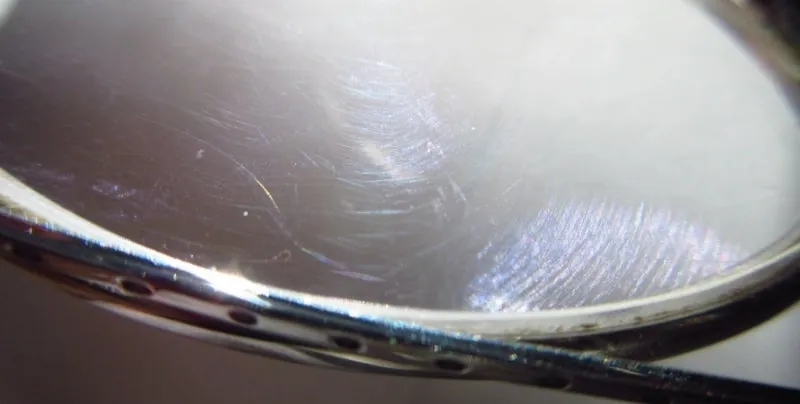
The same conversation came around every week. A patient would come back six or eight months later saying their lenses looked “dull,” “flat,” “still blurry even after I clean them.” I would put them under the lensmeter and see the same thing every time: a web of hairline scratches, all running in the direction of the wipe.
The explanation is simple and uncomfortable. The dust that settles on a lens is not soft. It is mineral — road silica, brake particulate, grit. When you pick up the cloth and rub, you are not removing that dust. You are dragging it across the anti-reflective coating, which is the softest layer in the stack. Every clean takes a little. Multiply by three times a day, for two years.
What changed when a rep left one on my desk
I was skeptical. The thing is called Peeps, it fits in a palm, and it looks like a futuristic clothespin. It sat in a drawer for two weeks.
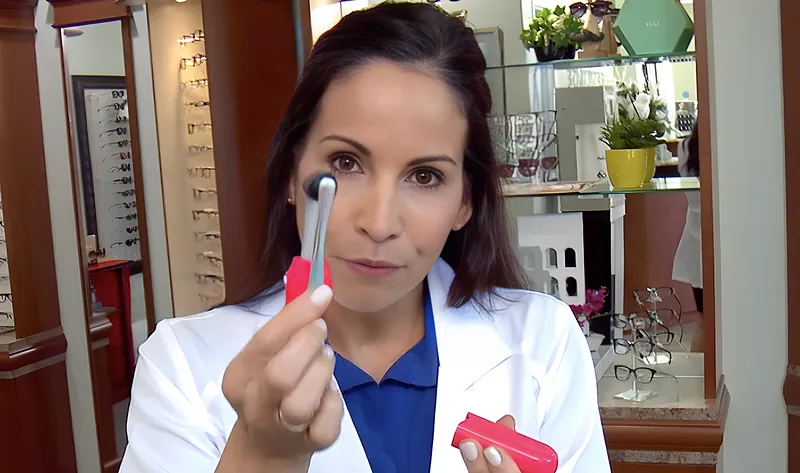
When I finally used it, what convinced me was not the cleaning. It was the order of operations. Peeps has a retractable brush you run over the lens first, to take off the abrasive grit before any fabric touches the glass. That is precisely the step the cloth does not have, and it is where the damage happens.
Only then do the carbon microfiber pads come in, on a clamp that does both faces of the lens in one pull.
A word on the marketing, since you will see it everywhere: the packaging and every retail listing say the carbon technology is used by NASA. I have no idea whether that is true and I have never found anything that establishes it. It also does not matter to me clinically. Brush before fabric is the whole of the mechanism, and it would work if the pads were made of nothing more exotic than good microfiber.
It does not just remove dust — it repels it
This is the detail that made me switch the whole practice. After a carbon clean, the lens has less tendency to attract dust back. In practice: the patient who was cleaning four times a day starts cleaning once.
And grease comes off. Fingerprints, spatter, hand cream — dry, without smearing. That normally takes a spray.
Where I still send people elsewhere
I am not going to pretend it is universal. Heavy oil — sunscreen in summer, thick hand cream — can need a second pass, and some of my patients still prefer a wet wipe for that. If someone only wears readers twice a week, I tell them the cloth in the case is fine and to save their money.
And the brush does not reach the groove where the lens meets the frame. Nothing pocket-sized does. That is still soap and water, once a month.
What colleagues have said
The manufacturer quotes other optometrists in its material, and I will pass two along with the caveat that they are supplied by the company, not collected by me:
“My patients love it, my staff loves it and I love it. It is a complete win.”
Dr. Hawkins, OD
“These are possibly the cleanest glasses I have ever had.”
Dr. Gormady, OD
The company also says more than 12,500 optometrists use it and that over 7 million units have sold. Those are its numbers, not audited ones. What I can tell you independently is that on Amazon it holds 4.3 stars across 840 ratings, and on Walmart 3.9 across 224 — which is a real distribution with real complaints in it, and more useful than any testimonial.
How to use it (fifteen seconds)
- Twist the base and run the brush over both sides of the lens. Do not rush this part.
- Clip the pads on and draw from the center to the edge.
- Close it and put it away. Each unit is rated for about 500 cleanings.
One practical note on buying
The genuine article is sold on Amazon and at Walmart for $19.99, and through the manufacturer’s own promotional page for the same $19.99 single, with multipacks that bring it down to $12.50–16.66 each. If you want one, buy it wherever is convenient. If you want three — and for something that lives in a pocket, a car and a desk drawer, three is not unreasonable — the pack is the only place the price actually moves.
Want the pros and cons before you decide? Read our full Peeps review — including why buying a single unit through our link makes no sense.