The problem nobody admits to
Everyone who wears glasses has the same ritual: take them off, breathe on them, wipe them on a shirt or on the little cloth that came with the frames, put them back on. Two hours later they are smudged again. Four months later there is a permanent haze that no cleaner touches.
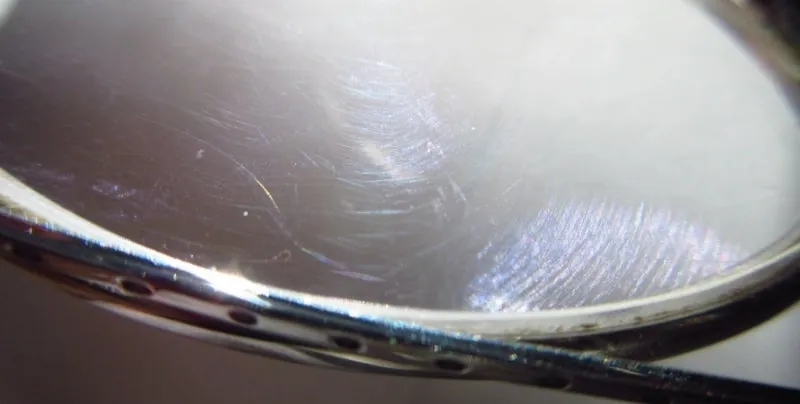
The haze is not dirt. It is the cloth. When you rub fabric over grit that is already on the lens, you are dragging fine sandpaper across the anti-reflective coating. Each pass leaves micro-scratches, and they add up until the whole lens reads as blurry. That is what we set out to test.
How it actually works
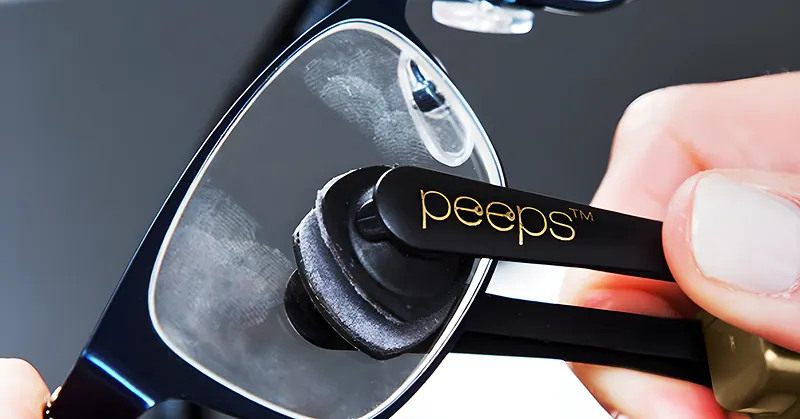
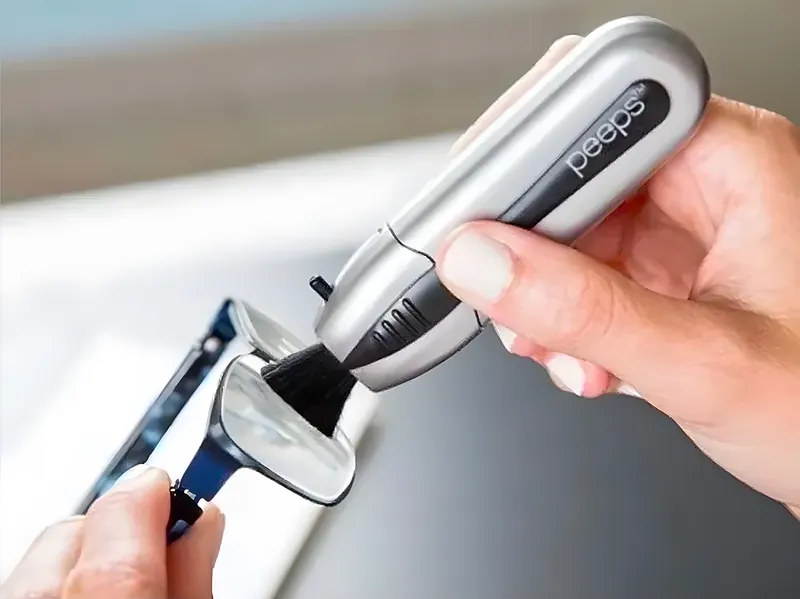
Peeps has two parts. A retractable brush that twists out of the body, and a clamp holding two carbon microfiber pads.
Using it correctly takes two steps, and the first is the one most people skip:
Step one — brush. Run the brush over both sides of the lens to lift the loose grit. This is the step that prevents the scratching. Skip it and you are back to sandpaper.
Step two — clamp and pull. Clip the pads onto the lens and draw them from the center out to the edge. Both faces get cleaned at once.
The whole thing takes about fifteen seconds. No liquid, no wet wipe, no breathing on the glass.
What six weeks changed
The thing that stood out was not how clean the lenses got. It was how long they stayed that way. With a cloth, the lenses were marked again within two or three hours. With Peeps, dust took much longer to settle, because the carbon leaves the surface slightly repellent instead of statically charged. We went from cleaning three or four times a day to once.
Second finding: finger grease comes off. Fingerprints, coffee spatter, the oily smear you get from cooking in your glasses — all of it lifts dry, without smearing. That surprised us, because dry cleaners normally just spread grease around.
About that “used by NASA” line
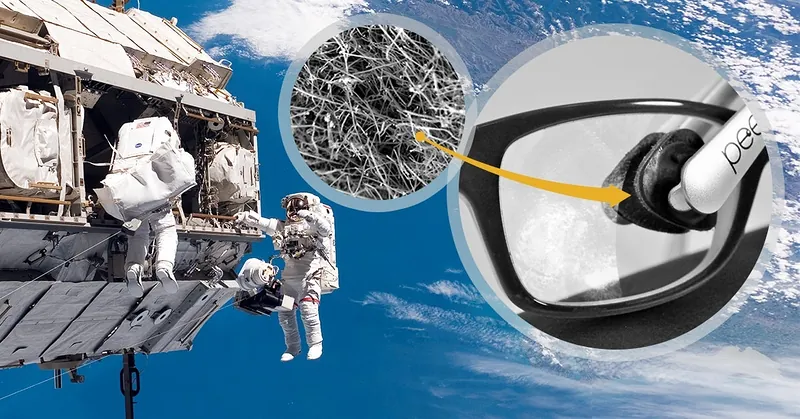
Every retail listing for this product carries it. Amazon’s bullet says the carbon technology is “used exclusively in space by NASA to clean glass.” Walmart puts “Exclusively Used by NASA” in the product title.
We went looking for something behind it and came up empty. There is no NASA publication, procurement record or statement we could find that mentions this product or this company. Carbon-based dry cleaning of optics is genuinely used in demanding settings — that part is not invented — but that is a fact about a category of material, not evidence that a space agency buys this particular tool.
Treat it as marketing. And note that it does not matter much either way: what makes Peeps work is the order of operations, brush before fabric. That would work the same if it had never been within a thousand miles of a launch pad.
Where it disappoints
Four things, and one of them is a correction to what we originally wrote.
The clamp only fits one way. On very small frames, or high-prescription lenses with a thick edge, you have to come in at an angle. The first few days are clumsy. It passes, but it takes about a week.
The brush is short. It handles the lens but does not reach into the groove where the lens meets the frame — which is exactly where grime collects. We still needed soap and water on the frames once a month.
It does not fix every smudge. This is the most common complaint in the Walmart reviews, and it is fair. Heavy grease — sunscreen, hand cream — sometimes needs a second pass, and a few reviewers report a cleaner and a soft towel doing better. Our experience was better than theirs, but we are one data point and they are many.
Replacement pads exist, and they are a trap. We previously wrote that the pads could not be replaced. That was wrong: Carbon Klean sells them. But they cost $19.99 on Amazon — the same as an entire new unit at retail, and more than a unit costs in any of the multipacks. So the pads are real and buying them makes no sense. The device is disposable by arithmetic rather than by design, which is not better, just more honest about what is going on.
What it costs, and where to buy it
Here is the part that decides whether this is a good purchase, and it is not flattering to the link we earn from.
One unit costs the same everywhere. The promotional funnel we link to charges $19.99. Amazon charges $19.99 (4.3 stars, 840 ratings). Walmart charges $19.99 (3.9 stars, 224 ratings). If you want exactly one, buy it wherever you already have an account — Amazon will get it to you faster and take it back more easily, and we will earn nothing. That is the honest answer.
The packs are where the funnel wins. Three for $49.98 works out at $16.66 each; five for $74.97 is $14.99 each; ten for $124.95 is $12.50 each, all with free shipping. Nothing at retail matches that.
Whether that is useful depends on whether you would actually use three. For a $20 object that lives in a pocket, a bag or a glovebox, that is less far-fetched than it sounds: one at home, one in the car, one at the desk. It is also the answer to the replacement-pad problem — a spare unit in a pack costs less than a set of pads.
The obvious cheaper alternative. Zeiss pre-moistened lens wipes cost about $11.98 for 225 of them, which is roughly five cents a cleaning against four cents for a Peeps at full price. On cost alone they are a wash. The difference is that the wipes are wet, individually wrapped, and you throw one away each time, and that they do not include a brush — so they solve the smear but not the scratching. Pick on that basis, not on price.
For
- The brush step removes the actual cause of scratching
- Lifts grease dry, without smearing
- Lenses stay clean far longer between cleanings
- Fits a pocket; goes everywhere
- No liquid, no refills, no wipes to throw away
- 30-day guarantee, no argument
- 4.3 stars on Amazon across 840 ratings
Against
- Clumsy to seat for the first week
- Brush does not reach the lens-to-frame groove
- Heavy grease can need a second pass
- One unit costs the same as on Amazon — no reason to use our link
- Replacement pads cost as much as a whole new unit
- The NASA claim has nothing behind it that we could find
Is it worth it?
Worth it if you wear glasses every day and have already replaced a lens because it went hazy. A prescription lens with an anti-reflective coating costs many times twenty dollars — if Peeps adds six months to one, it has paid for itself several times over.
Not worth it if you wear glasses occasionally, say only for night driving. The cloth that came with the frames is fine for that.
And if you are buying: one unit, buy it on Amazon. Three or more, buy the pack. We would rather say that plainly than watch you find it out on your own two minutes after clicking.
Three for $49.98 — $16.66 each, free shipping
SEE THE MULTIPACKS →30-day money-back guarantee · single units cost the same on Amazon