If you clean your glasses and they still have that faint haze, stop looking for a better cleaner. The problem is not the dirt. It is the method.
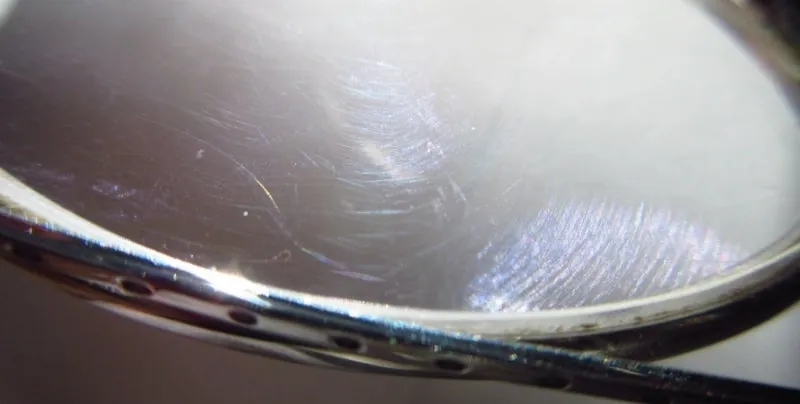
The arithmetic nobody does
Someone who wears glasses cleans them about three times a day. That is more than a thousand cleanings a year. If each one drags mineral grit across the anti-reflective coating, you have put a thousand passes of fine sandpaper on your lenses in twelve months.
That is not an exaggeration. The dust that settles on a lens is not lint: it is silica, road residue, brake particulate. Mineral hardness. The anti-reflective coating, on the other hand, is the most delicate layer in the stack — it is built to let light through, not to survive abrasion.
A microfiber cloth is excellent after the grit is gone. The problem is that nobody removes the grit first. You pick up the cloth and rub.
The four methods you have already tried, and why they fail
The shirt. Coarse cotton, usually carrying fabric softener residue. The worst case available.
Breathe, then rub. The breath deposits saliva and oil. The rub spreads it around and grinds the grit in at the same time.
Soap and water. This genuinely works, and it is the one good household answer. The catch is that you are not going to a sink three times a day at work.
Spray and a wipe. Good results. Zeiss pre-moistened wipes run about $11.98 for 225, which is roughly a nickel a cleaning — not expensive. But you are carrying two things, or throwing away a foil packet every time, and neither the spray nor the wipe lifts the grit before the fabric arrives.
What changes when you reverse the order
The answer is not a better cloth. It is splitting the job in two: remove the abrasive particle dry, with no fabric contact, and only then polish.
That is what Peeps by Carbon Klean does. A retractable brush takes the loose grit off both faces. Then a clamp with carbon microfiber pads cleans both sides of the lens in a single pull.
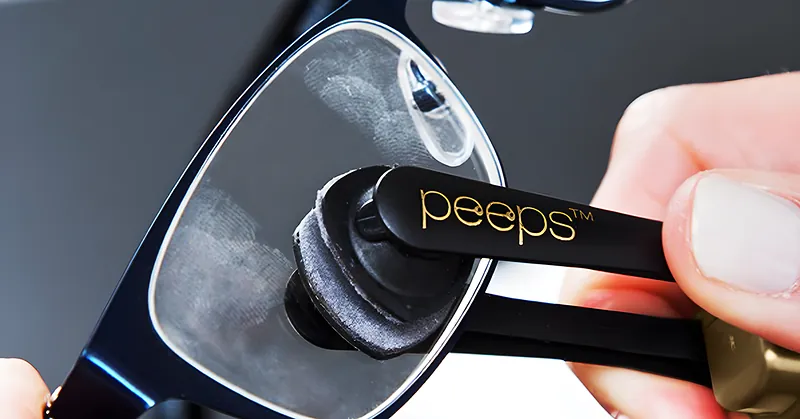
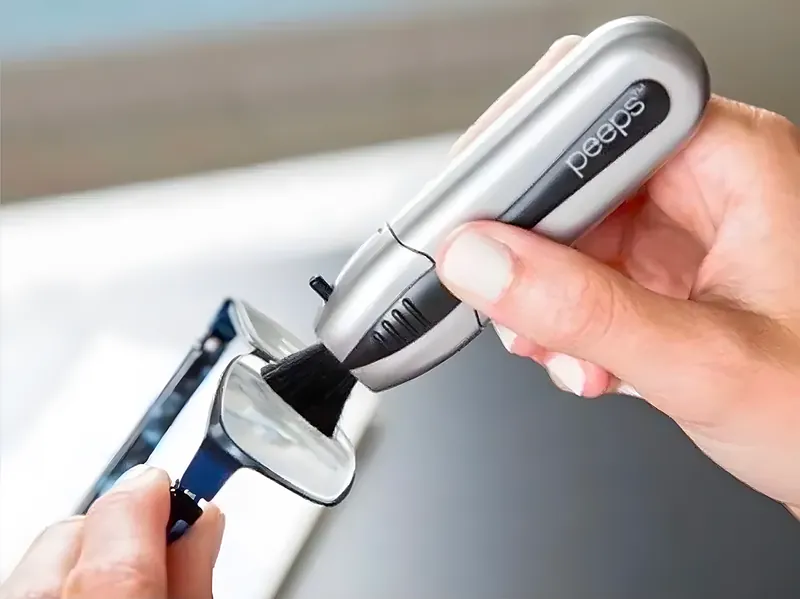
The carbon adds something ordinary fabric does not: instead of leaving the lens statically charged and pulling dust straight back, it leaves the surface slightly repellent. People who use it report going from three or four cleanings a day to one.
“These are possibly the cleanest glasses I have ever had.”
Dr. Gormady, OD — quoted in the manufacturer’s material
The numbers, and which of them to trust
- 4.3 stars on Amazon across 840 ratings; 3.9 on Walmart across 224. These are the ones worth weighing — they come with a star distribution and real complaints.
- Over 7 million units sold and more than 12,500 optometrists using it. Manufacturer figures, not audited.
- About 500 cleanings per unit — call it a year of normal use.
- $19.99 for one, the same as Amazon and Walmart. $16.66 each in a three-pack, $12.50 in a ten-pack.
Set against the cost of replacing a coated prescription lens because it went hazy, the case is not hard to make. Set against buying a single unit from a link that earns us a commission when Amazon charges the same and ships it faster — that case we are not going to make. Buy one there. Buy three here.
Stop sanding your lenses three times a day
Want the downsides too? Our full review lists the six things we hold against it, including the replacement pads that cost as much as a new unit.