The problem this actually solves
Ask around and you will find that most families have already tried. Somebody bought the leather journal with the prompts in it. Somebody set up a shared folder. Somebody has a voice memo from a Thanksgiving four years ago that nobody has listened to since. The intention is never the missing piece.
The missing piece is that recording a life is a chore with no deadline, and it lands on a person in their eighties who is not going to give themselves one. Every product in this category has to solve that, and they solve it in exactly two ways: send the storyteller a prompt and hope, or take the work off them entirely.
Memorygram is the second kind, and that is the whole reason to consider it. Once a week, at a time your family picks, the phone rings. Someone asks a question about their life. They talk for five to fifteen minutes — up to thirty if they are on a roll — and hang up. The audio and a transcript land in an account that somebody else in the family manages. After about six to eight months of that, there are enough stories for a book, and the book gets printed.
The storyteller needs no internet, no smartphone, no app and no password. A landline works. That sounds like a small technical detail and it is the entire product: it is the only one of the four services we compared that asks a parent to do nothing but answer a phone they were already going to answer.
The thing the sales page leaves out
Reading the product page, you would form the picture of a warm professional on the other end of the line. Two of the review sites we found while researching this say so outright — one of them states the calls are “human-led rather than AI-automated.”
That is wrong, and Memorygram’s own blog says so in plain words: “a friendly automated interviewer leads the conversation and offers gentle prompts.” It asks a question, listens, and follows up. Your storyteller can ask it for a different question if the one it picked does not land. It is a machine, and the company does not hide it once you are past the sales copy.
We are putting this in the third section rather than burying it, because it is the fact most likely to cause a bad afternoon. If you buy this for a father who thinks a journalist is going to call him, he will figure it out in the first ninety seconds, and he will be annoyed at you, not at Memorygram.
Told up front, it is a different conversation, and an easier one. Automation is why this costs $98.80. A human being who interviews your mother weekly for eight months, transcribes it and shapes it into a book is a personal historian, and Reedsy’s 2026 rate data puts full-length memoir ghostwriting at $18,000 to $50,000. There is no version of this service with a person on the line at a hundred dollars. The honest question is not whether a machine is as good as a writer — it is not — but whether a machine that actually calls every week beats a human who was never going to be hired.
What you get for the money
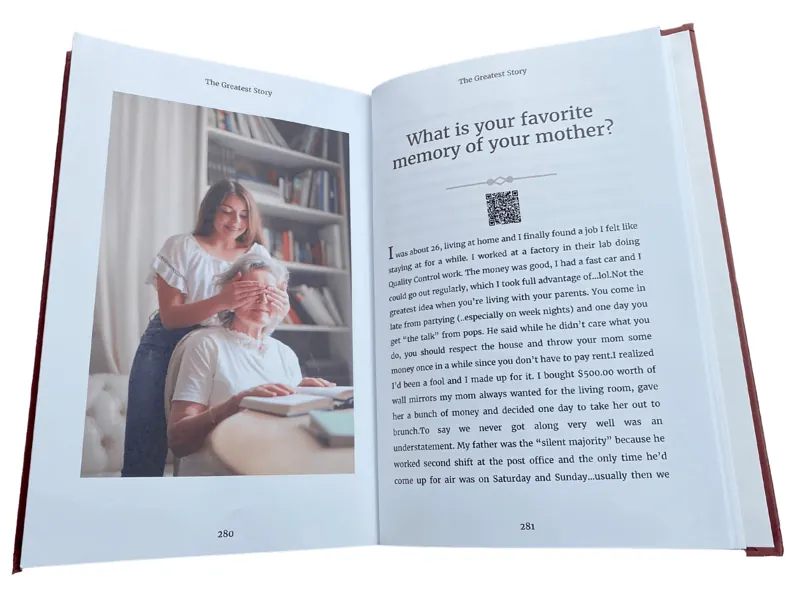
The finished object is 8.5 by 11 inches, hardcover, full color throughout rather than color cover and black-and-white insides. It runs to a maximum of 450 pages, which the company frames as roughly sixty questions answered with photographs; most books come in at thirty-five to fifty-five stories. A PDF e-book is included.
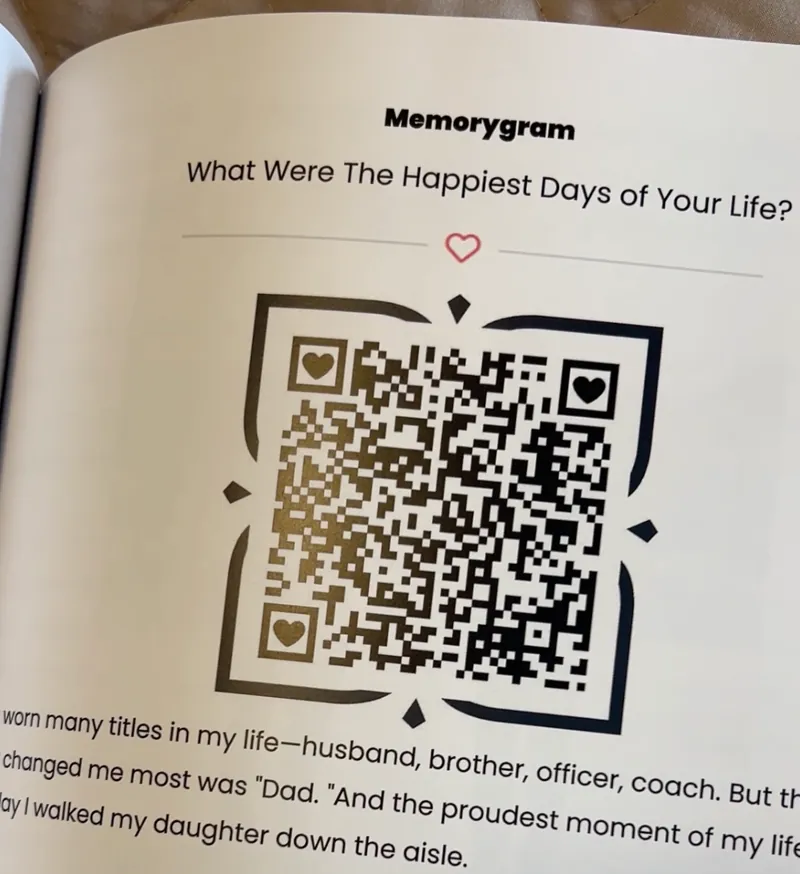
Each story carries a QR code. Point a phone at it and you hear the recording — the actual voice, the pauses, the laugh. It is the feature everyone writes about and it is the feature we would rank third, because Remento does the same thing for a similar price. The QR codes are not why you would choose this.
The price, and the price after the price
List is $123.50. It is $98.80 as we publish, in a Grandparents Day sale, and this brand appears to run a named sale most of the year, so treat $98.80 as the real price and $123.50 as the number it is measured against.
Then the add-ons, which is where the honest number lives. Extra printed copies are $77 each, up to ten. A digital copy is $19.99. A second storyteller — both parents in one project — is $50.
Run that against a normal family. One book, three grown children, everybody wants one: $98.80 plus two copies at $77 is $252.80. Both parents, three copies: $302.80. The BBB complaint file has a customer refunded $304.74 for a single order, which tells you these are the real order sizes, not the sticker.
That is not a scam and every competitor charges for extra copies too — StoryWorth wants $79 to $99 for a second book, Remento $69. But $98.80 is the price of the version nobody buys, and you should walk in expecting $250 to $330.
And shipping is not quoted at checkout. The company says shipping “is calculated when your finished book is ready to print,” which is six to eight months after you pay. Inside the US that is a minor annoyance. Shipping a stack of 450-page hardcovers to an address outside the US, at a price nobody will name today, is an open number in a purchase that is already three hundred dollars.
How it compares with the three obvious alternatives
All prices checked on 10 September 2026, on each company’s own site.
| Memorygram | StoryWorth Basic | StoryWorth Unlimited | Remento | |
|---|---|---|---|---|
| Price | $98.80 once | $59 | $199 | $99 |
| Renews | No, ever | Per year, per book | Auto-renews $99/yr | $99/yr or $12/mo |
| Book | 450pp, full color | 480pp, b&w inside | Two, 300pp color | 200pp ($30 for 380) |
| Weekly phone interview | Yes | No, email prompts | Yes | No, app recording |
| Needs internet | No | Yes | Yes | Yes |
| Voice in the book | Yes, QR | No | No | Yes, QR |
| Extra copies | $77 | $39–$99 | $39–$99 | $69 |
Read that table twice, because the first read is misleading. The cheapest thing here is StoryWorth Basic at $59, and if your parent will happily answer an email every week, buy it and save forty dollars. That is a real recommendation and we would rather you took it than clicked our link.
The comparison that matters is the second column from the right. StoryWorth also runs weekly guided phone interviews — in the $199 Unlimited plan, which auto-renews at $99 a year. So the honest framing is not “only Memorygram calls your mother.” It is that the phone-interview tier costs $199 up front and keeps billing, against $98.80 that never bills again. Over two years: $298 against $98.80.
Remento is the closest on price and the furthest on friction. It is a good product built for a storyteller who will pick up a phone and use an app. If that describes your parent, they were probably going to manage StoryWorth too.
Where it disappoints
We have not run this ourselves, so these come from the complaint record and from what the design plainly cannot do. The Better Business Bureau lists Memorygram.com as accredited with an A rating and 14 complaints in three years, 11 of them closed in the last twelve months. That is a small number for a company with thousands of customers. What matters is where they cluster.
They cluster on the phone calls. The single feature you are buying is the one generating service complaints: a January 2026 filing describes repeated technical failures on calls with an elderly grandfather and recordings that were lost. If the calls are the product, a call that does not record is not a glitch, it is the product failing.
The guarantee expires before you know anything. The stated policy is thirty days, and it is void “as long as no books are printed” — printed books are custom and cannot be returned. Now put that against a program that runs six to eight months. Your money-back window closes in month one; you find out whether your father enjoys the calls in month two; you find out whether the book is any good in month eight. One BBB complainant was told the window — described there as seven days — had already passed when their mother turned out to be too ill to take part. Memorygram eventually refunded them in full, $304.74, and to their credit they resolved nine of the fourteen. But you are relying on goodwill, not on a policy.
Support is not fast when it goes wrong. Trustpilot puts the company at 4.5 out of 5 across 163 reviews, with 78% at five stars — a good score, on a profile claimed since December 2021, which is longer than most funnel brands have existed. The same page notes the company replies to 100% of negative reviews and typically takes over a month to do it. A September 2025 BBB complaint from a customer who paid $106, got no confirmation email and could not reach anybody is still marked answered rather than resolved.
The prompts are generic until you fix them. A verified reviewer reported rewriting “almost half” of the supplied questions because they were not hitting the mark. You can edit them, and somebody in the family probably should, which means this is not quite the hands-off purchase it looks like.
The pages are matte and thin. More than one reviewer would prefer a heavier gloss stock; one called the pages delicate enough to worry about, on an object explicitly sold as an heirloom.
And the software is the weak half. The most quoted complaint about the editing interface: “like trying to solve a puzzle without the picture on the box.”
For
- Nothing required of the storyteller but answering a phone
- Works on a landline — no internet, app or password
- One payment, no subscription, no auto-billing
- 450 full-color pages, the most in the category
- Cheapest route to weekly phone interviews by a wide margin
- BBB accredited with an A rating; Trustpilot 4.5 across 163 reviews since 2021
Against
- The interviewer is automated, and the sales page lets you assume otherwise
- Refund window closes months before the book exists
- The complaints that exist are about the phone calls
- Shipping is not priced until the book is ready to print
- Realistic family order is $250–$330, not $98.80
- Replies to negative reviews average over a month
- StoryWorth Basic is $40 cheaper if your parent will type
- Not tested by us
Is it worth it?
Worth it for one specific person, and if you recognize them you should stop reading and go: a parent or grandparent in their seventies or eighties who tells good stories at the table, has never opened an app in their life, maybe still has a landline, and has been saying for a decade that they should write some of this down. For them the alternatives are not cheaper, they are theoretical. Nothing that requires typing is going to get done, and $98.80 for a machine that calls every Tuesday is the only proposal on this list that survives contact with reality.
Not worth it if your parent is comfortable with email. Buy StoryWorth Basic at $59. It is the same idea, it produces a longer book, and you keep forty dollars.
And not worth it as a surprise. This is the one thing we would push back on hardest, because the sales pages for the whole category are built around the gift-wrapped reveal. A surprise commits somebody else to eight months of weekly phone calls they did not agree to. Ask them first. If the answer is yes, you have a project with them; if the answer is no, you just saved three hundred dollars and a difficult Christmas.
One last piece of arithmetic, and it is the one that decides it. The most common outcome in this category is not a bad book. It is no book — the journal in the drawer, the subscription that lapsed, the folder nobody opened. Measured against a $59 product that produces nothing because nobody ever writes in it, a $98.80 product that produces a book is not the expensive option.
$98.80 in the Grandparents Day sale, down from $123.50
SEE THE CURRENT PRICE →One payment, no renewal · ask the storyteller before you buy